Welcome to the uracoli Blog

µracoli stands for microcontroller radio communications library and is intended to be a package that demonstrates capabilities and usage of Atmel's IEEE-802.15.4 radio transceivers AT86RF{230,231,212} in combination with AVR 8 bit microcontrollers (e.g. ATmega16, ATmega1281, ATmega128RFA1, ...).
Posts mit dem Label applications werden angezeigt. Alle Posts anzeigen

Mittwoch, 31. Dezember 2014

"Biomeiler" data logging

Since there are a lot of leave trees in my garden, every year in autumn it is a busy time to remove the leaves from the ways and meadows. I was thinking what else can be done with this amount bio mass, then simply let it rot. Depending on the sort leaves it may rot slowly and it can take several years until a leave becomes soil.
Once a day I stumbled across the concepts of Jean Pain, a french lumberjack and inventor. He did setup huge piles of shreddered branches and observed that inside this piles high temperatures are achieved. Within such a pile water can be heated up to 70°C,  this can be read on the internet.  The reason is, that the shreddered bio mass rots aerob, e.g. in the presence of oxygen. In the logical consequence Pain added a heat exchanger in the pile and so he could use the energy generated by the bacteria to heat his house and he also could produce methane - natural gas - to drive cooking stoves, cars and agricultural machines. Pain's work is documented in the book The methods of Jean Pain or another Kind of Garden (or as online version). B.t.w. the german word "Biomeiler" can be translated with "heating compost".

Montag, 29. Juli 2013

RaspBee - An IEEE-802.15.4-Module for RasperryPi

Introduction

The µracoli team recently got one of the new RaspBee modules from dresden elektronik (DE) for evaluation. The RaspBee is a addon module for the popular Raspberry Pi computer and is equipped with an Atmega256RFR2. Due to its huge amount of RAM and FLASH and the integrated transceiver, this MCU is a smart choice for building ZigBee or IEEE 802.15.4 gateways.

The very popular Raspberry Pi needs probably no extra introduction. The credit card size ARM computer runs Linux (e.g. Raspbian) and it has USB and Ethernet interfaces, which makes it perfect for DIY projects.

Esentially the RaspBee consists of a radio module deRFmega256-23M12, is equipped with a ceramic chip antenna, the footprint for an U.FL coaxial connector, two LEDs and a (not populated) JTAG connector. The 12 pin header connects the RaspBee with the Raspberry Pi over the expansion connector. This connector provides power supply and serial port as well as one digital GPIO and the Reset pin.

The RaspBee is preprogrammed with a proprietary serial bootloader. For this bootloader, DE provides the tool GCFFlasher. It runs on the Raspberry Pi and provides a convenient and safe way to upgrade RaspBees firmware.

Caution: If you want to programm the RaspBee via the JTAG interface, the original DE bootloader firmware will be destroyed and because the flash protect fuses are set, there is no way to do backup in advance. The bootloader firmware makes the difference between the basic version (capable to handle 5 ZigBee nodes) and premium version (handles up to 200 ZigBee nodes). However upgrading the firmware with GCFFlasher is safe. You can always restore the firmware image from the DE download page.

Basic Setup

Before you can run your own firmware on the Raspberry Pi / RaspBee hardware, some prerequisite steps are required. For detailed information refer to the RaspBee User Manual.

Sonntag, 9. Juni 2013

IPSO challenge 2013

The winners of the IPSO challenge 2013 was announed last week here. Colorado Micro Devices, you may know this guys already from the RadioBlock modules, participated in the challenge, came among the top 10 semi finalists and finally made it to the second place. How is that related to µracoli? Simply by the fact that we reused parts of this years Chemnitz Linux Days project. Especially this was  Icinga, that  was installed on a Raspberry-Pi and on a Cloud server. In difference to the Linux Days project we used MQTT instead of SNMP. MQTT makes it easier to operate from behind a firewall, since the local Rasperry-PI needs no official IP address, in order to be reached from the server, instead it publishes the sensor data to the cloud server actively. Thanks to the open source MQTT implementation from the Mosqitto project, we could quickly change from SNMP to the new protocoll, that fits perfectly as transport layer for sensor data.

Mittwoch, 1. August 2012

µracoli is going to space

Launching Rocket
Since the last year Torsten and his son David are engaged hobby rocket scientists. They work with modell rockets, which have usually a lentgh of 15cm to 2m. These models are made of cardboard or glass-fiber plastics and are powered by solid fuel engins or hybrid engins. Modell rockets usually reach heights from 100m up to 1500m over ground, depending on the size of modell and the engine.

Beside the fun of designing and building the models, they also wanted  to measure data during the flight and send them in realtime to a ground station. As ground station a laptop with an Sensor-Terminal-Board from dresden elektronik was used. This boards have the advantage that they use a parallel to USB converter FT245BM, that allows high data rates between the microcontroller and the PC. The live data was written to logfiles and postprocessed later to get the resulting graphs and diagramms.

ROSE board mouned in rocket tip
Daniel build a circular PCB called ROSE (rocket sensor), consisting of an ATmega, an AT86RF231 transceiver and several sensors to measure physical parameters like air pressure, acceleration and earth magnetic field. This parameters are sent wirlessly to the ground station and logged on the Laptop.

For general information about modell rocket sports , check this page http://www.ag-modellraketen.de/ (in german).

Freitag, 22. Juni 2012

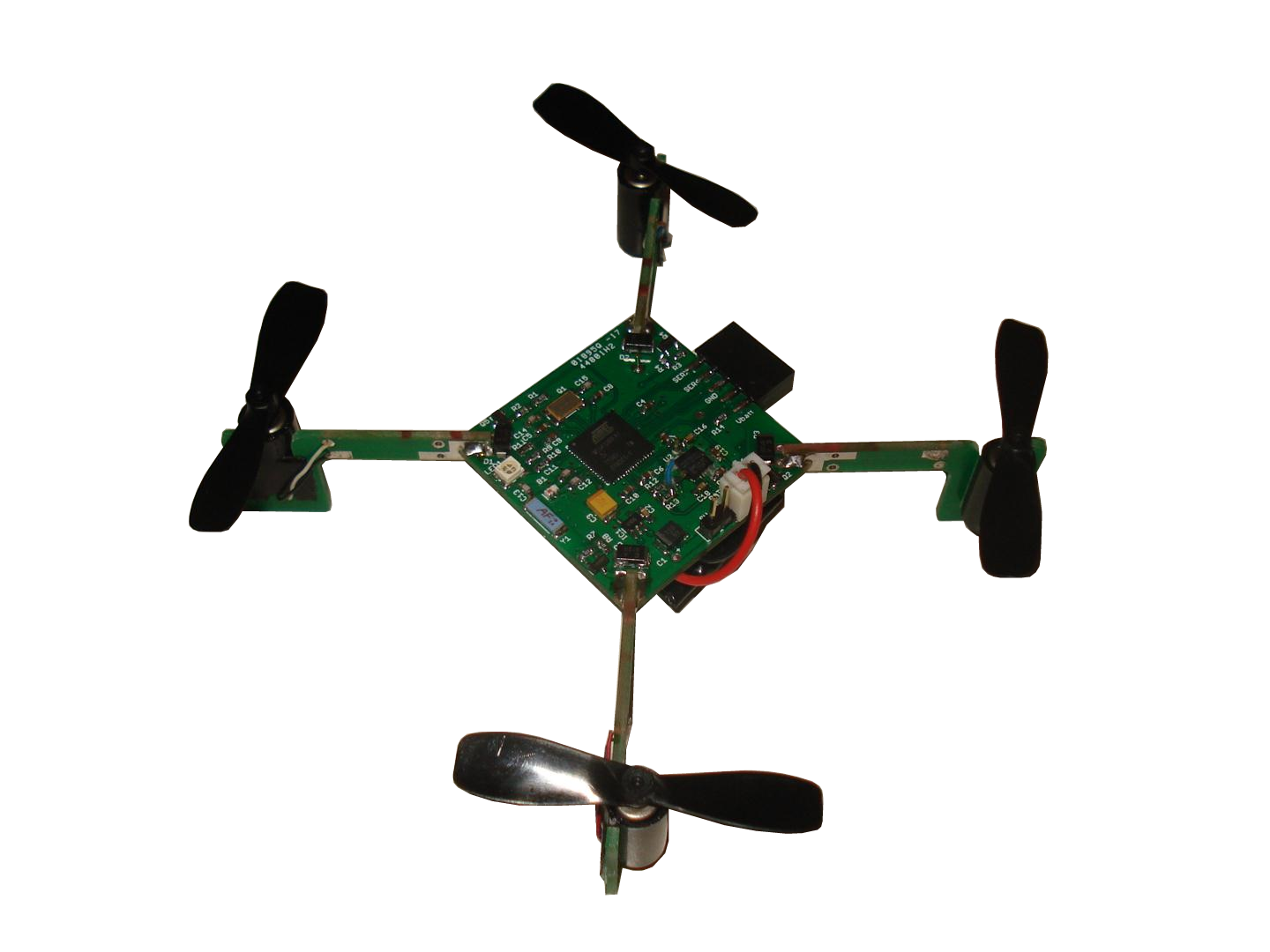
Picopter Instructable

Today a friend stumbled across Frank Zhaos Picopter project that is documented at http://www.instructables.com/id/Picopter/. The project basically consists of two PCBs, one is used as base station, connected with a Wii-Controller and via USB port with the PC. The other one is the flight modell, the "one-hand-sized" tiny little quadcopter. It looks like the ideal toy for kids up to the age of 40++ ;-).

Mittwoch, 5. Januar 2011

uracoli "spotted" in the news


Le Monde, a major newspaper in France, published on December 31th, 2010, an article about a show (Vibrations, by Compagnie 14:20) I worked for, with a large picture of the juggler, Etienne Saglio. The juggle ball on the picture runs uracoli, and is one of 50 nodes used in the show. Happy new year uracoli !